There is a children’s book called Petro Pete’s Big Bad Dream.
It sounds like something a comedian would invent two drinks into a bad week. It isn’t. It was published in 2016 by the Oklahoma Energy Resources Board, a state agency created at the oil industry’s request and funded by a small voluntary assessment (a fee, basically) on the sale of Oklahoma oil and gas. In the book, a boy named Pete dreams that everything made from petroleum disappears: his toothbrush, his comb, his bike tires, the school bus. He wakes up relieved.
This isn’t a fringe pamphlet. A 2017 Center for Public Integrity investigation found that the board had spent upwards of $40 million on K-12 education over two decades, that some 14,000 Oklahoma teachers had attended its workshops, that more than 9,000 free copies of the Petro Pete book had gone to schools and libraries, and that its materials were used in 98 percent of the state’s school districts.
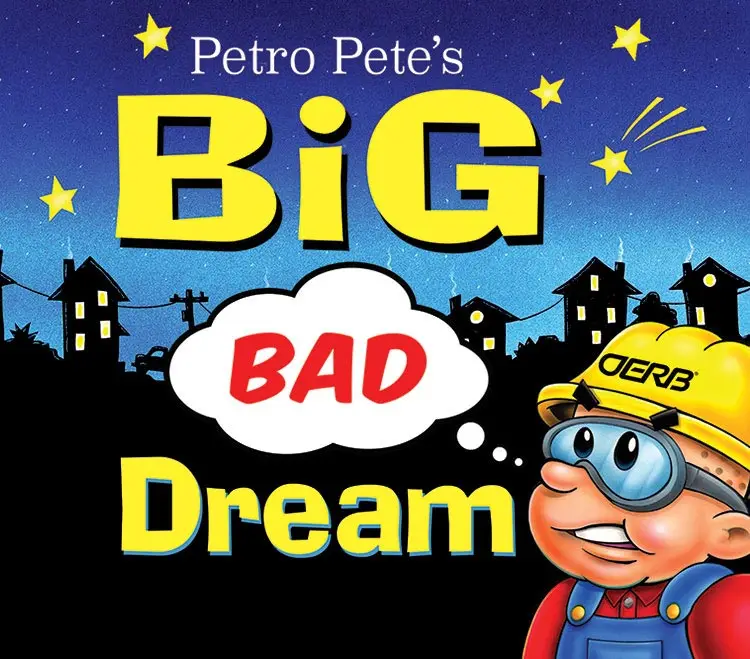
You can spend years hearing that climate education is indoctrination and that environmentalists want to brainwash kids, and then you find out the oil industry has a cartoon mascot walking into classrooms to explain that petroleum is the hidden friend inside everything a child loves.
It would be funnier if it weren’t so well funded.
Help, Delivered
None of this requires a villain in the teachers’ lounge. Teachers are overloaded and schools are underfunded. We have a special talent in this country for demanding miracles from classrooms while funding them like a bake sale. Free materials are tempting, and polished free materials are very tempting.
That’s the opening. An industry with a public-relations problem doesn’t need to kick down the classroom door. It can show up with posters, lesson plans, videos, field-trip money, and a cheerful character, and be thanked for it.
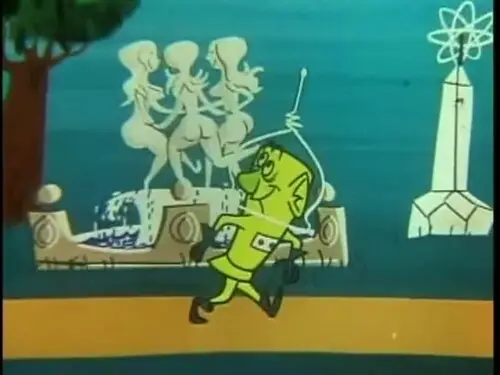
And it has, for a long time. In 1956 the American Petroleum Institute paid for Destination Earth, a Technicolor cartoon in which a Martian envoy visits Earth and discovers that oil and free competition are the secret of the good life. (The Martian dictator replies that competition is “downright un-Martian.” The Martians overthrow him.) In 1982 Exxon opened the Universe of Energy pavilion at Disney’s EPCOT, a ride with animatronic dinosaurs that it sponsored for 22 years. Oklahoma has Petro Pete.
Most of these materials aren’t lies. Petroleum really is in toothbrushes, clothes, toys, phones, asphalt, medicine, and packaging. Modern life really was built on it. A kid who learns that has learned something true.
But there are two ways to teach a true thing. One is to explain how industrial society developed, what petroleum made possible, what it costs (pollution, climate risk, geopolitical dependence, plastic waste), and what the alternatives look like. The other is to teach that without oil, civilization disappears and the people who sell it are its guardians.
The second version is propaganda. Not because every sentence is false, but because the frame is rigged. The benefits get a name and a mascot. The costs get a fog machine.
From “We Need Oil” To “Nobody Knows”
By the late 1980s the industry had a bigger problem than gratitude. Its own scientists were telling it that burning fossil fuels would warm the planet, and they turned out to be right. A 2023 study in Science went back through the climate projections Exxon’s researchers made between 1977 and 2003 and found that most of them, 63 to 83 percent, were consistent with the warming that actually followed.
The public messaging went the other way.
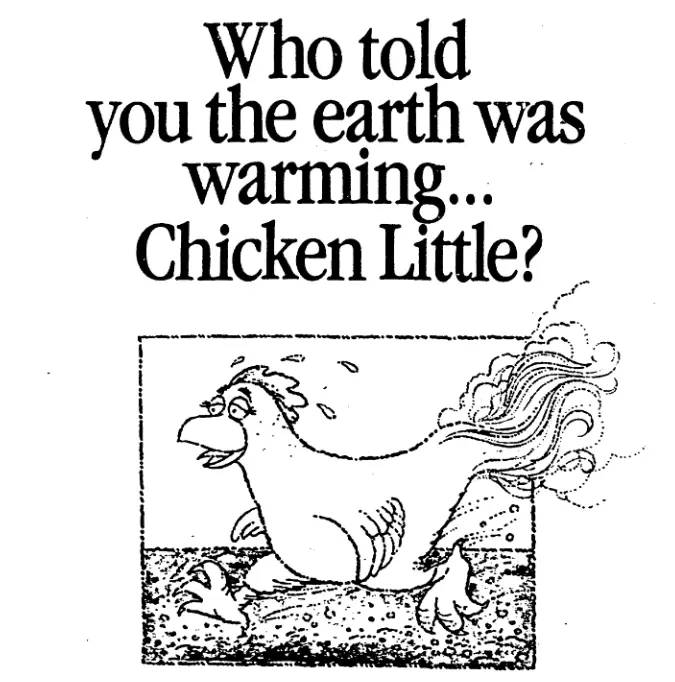
In 1991 a coal-and-utility industry group calling itself the Information Council for the Environment test-marketed a newspaper and radio campaign in Fargo, Flagstaff, and Bowling Green. Its internal planning documents, now public, list the first strategy plainly: “Reposition global warming as theory (not fact).” One ad asked who told you the earth was warming. Its answer: Chicken Little.
In 1998, a team convened by the American Petroleum Institute, with people from Exxon, Chevron, and the Southern Company, drafted a “Global Climate Science Communications Plan.” The New York Times got a copy. Under the heading “Victory Will Be Achieved When,” the first item reads:
“Average citizens ‘understand’ (recognize) uncertainties in climate science; recognition of uncertainties becomes part of the ‘conventional wisdom.’”
The plan called for cultivating scientists “whose research in this field supports our position.” And it had a section on schools:
“Informing teachers/students about uncertainties in climate science will begin to erect a barrier against further efforts to impose Kyoto-like measures in the future.”
In 2017, the Heartland Institute started mailing an unsolicited book called Why Scientists Disagree About Global Warming to American science teachers, 25,000 at a time. By the end of that year, about 350,000 copies had gone out.
I’m not bringing this up to make you feel bad about what you learned in fourth grade. I’m bringing it up because “the other side is the one doing propaganda” is a common sense that was, in part, manufactured by people who wrote down that they were manufacturing it.
Propaganda Lives In The “Therefore”
Most people picture propaganda as a villain saying the sky is made of soup. Real propaganda is usually more boring and more effective. It arranges true things so they protect someone.
“Petroleum is in many products” is true. “Therefore the oil industry deserves political protection forever” is the move.
“Natural gas burns cleaner than coal” is true. “Therefore we should build decades of new gas infrastructure and call it climate progress” is the move.
Propaganda lives in the therefore.
The industry’s biggest win was never convincing Americans that pollution is good. Hardly anyone believes that. Its biggest win was making fossil fuels feel normal in a way competing technologies don’t. A refinery is just there. A pipeline right-of-way is just there. A school worksheet about petroleum is just education. A tax break from 1926 is just policy.
Then a solar farm shows up and suddenly everybody’s a philosopher of land, wildlife, and mineral supply chains. Fair enough. Those concerns are real (Chapter 5 takes the land one seriously), and solar doesn’t deserve less scrutiny. Fossil fuels deserve the same amount, and decades of “this is just how life works” are the reason they usually don’t get it.
What Honest Energy Education Would Look Like
The fix isn’t solar propaganda. Nobody needs a cartoon called Sunny Sam’s Big Beautiful Electron Dream in which a brave little panel defeats the evil pipeline while everyone applauds in a net-zero amphitheater. Please, no.
Kids need to learn that energy is tradeoffs. Fossil fuels built much of modern life and came with enormous costs. Solar and wind cut some of those costs and bring their own problems. Nuclear is powerful and expensive and politically fraught. Hydro is great until you’re the river. Batteries are useful and material-hungry. Efficiency is boring and underrated. Transmission is necessary and miserable to permit. No source is a religion, and no source is the devil.
That kind of education would make all of us harder to manipulate, which is probably why it’s not the kind lobbyists tend to fund.
The Streaming Version
If you think this stopped with filmstrips and coloring sheets, open your streaming apps.
Landman premiered on Paramount+ in November 2024 and was watched in 14.9 million households worldwide in its first four weeks. In the third episode, Billy Bob Thornton’s oil-company fixer, Tommy Norris, explains to a lawyer why wind turbines are a joke. Think how much diesel it took to mix the concrete, make the steel, and haul the parts out with a 450-foot crane, he says, and how much oil it takes to lubricate and winterize the thing. “In its 20-year lifespan,” he concludes, “it won’t offset the carbon footprint of making it.”
The clip went viral, and you can see why: a tough realist cutting through green nonsense while a naive outsider learns how the world works.
If you haven’t seen it, watch it before reading on. Pay attention to the casting of the roles before you think about the facts.

The oilman is the adult who understands reality. The skeptic is the naive one receiving hard truth. That framing does most of the work before a single fact arrives.
Clip ↗It’s good television. Movie stars, danger, swagger, workplace competence, and the particular Taylor Sheridan pleasure of watching a man explain the brutal facts of life in a cigarette voice. Liking it doesn’t make you a dupe.
But the speech’s punchline is false. A Houston Chronicle fact check, which also ran in the Midland Reporter-Telegram in the heart of the Permian Basin, put it plainly: yes, fossil fuels are burned to make and move turbine parts, but it’s false that a turbine won’t offset its carbon footprint over its lifetime. A University of Texas researcher estimated the payback, the time it takes a turbine to make up for the emissions from building it, at about a year. A study of more than 4,000 turbine sites in Europe put the average greenhouse-gas payback at about five months. After that, the turbine runs nearly carbon-free for the rest of its 20-plus years.
The true part (turbines are built inside an industrial economy that still runs heavily on fossil fuels) is real. The “therefore” (so they’re pointless and oil is forever) is the move.
Tommy’s closer is the most revealing line in the scene: “If Exxon thought them things right there were the future, they would be put all over the goddamn place.” Notice who gets to decide what the future is. (Also, they are all over the place. Texas has more wind turbines than any other state. They just mostly weren’t put there by Exxon.)
Notice where the show came from, too, because it’s a nice example of how this works without anybody issuing orders. Landman is adapted from Boomtown, a well-reported 2019 podcast about the Permian oil boom from Texas Monthly and Imperative Entertainment, hosted by the writer Christian Wallace, who co-created the show with Sheridan. Nobody built it as an oil commercial. It grew out of real reporting about a real place, which is exactly what makes it persuasive.
Then the lobby noticed. When the second season premiered in November 2025, the American Petroleum Institute launched a national “Real Landman” campaign built around the show. “Landman reflects a broader shift toward energy realism,” API’s chief executive said. The campaign site spotlights real oil-field workers and invites viewers to “sign-up to be an Energy Citizen.”
That isn’t a smoking gun, and it doesn’t need to be. A reported story becomes a prestige drama, one scene becomes a viral clip, and the clip becomes “finally someone said it.” The lobby doesn’t have to write the script. It just has to show up after the clip goes viral and help the audience understand what it means. API is the group that did it in public. It isn’t the only industry group whose business includes making old energy feel like the default.
The longer breakdown, after you've seen the scene. The point isn't that shows about oil are forbidden. It's that entertainment is one of the places people pick up common sense.
Source page ↗Tommy does get one thing right: he says America doesn’t have the transmission lines to go electric. He’s right about the wires. Chapter 8 takes that up.
So if your skepticism switches on when a solar company runs an ad, it should also switch on when the oil lobby wraps itself around a prestige drama where the oilman is always the adult in the room. If it only trips for one of them, ask who set the switch.
Inspection, Not Shame
Most of what any of us call common sense is inherited. We like to think our opinions arrived straight from our own rugged brains, ideally after a brief hike. But all of us were shaped by school, work, family, media, and the industries that profit from our assumptions.
No shame required. Inspection is enough. If an industry spent decades making itself feel like civilization, you’re allowed to ask whether that story still serves you. If a label like “green” turns a practical machine into a moral costume, you’re allowed to take the costume off.
Oil became normal because people worked very hard to make it normal. And sometimes the work doesn’t need a cartoon or a TV show at all. Sometimes all it takes is one well-chosen word.
Natural.